
The Supreme Court Was Never Above Politics
I hope everyone has been paying attention.
The Supreme Court’s decision in Louisiana v. Callais marks a devastating turning point for civil rights. The Court has made it significantly harder to stop racial discrimination in redistricting, allowing partisan goals to serve as a shield for maps that dilute the voices of Black voters and other communities of color. With each paragraph of the decision, rights that generations relied upon vanish. With this decision, longstanding protections under the Voting Rights Act are stripped away, replaced by new barriers limiting our ability to challenge racial discrimination in our democracy.
For many, this marks not only the end of a legal doctrine but the loss of faith that the Court is a fair and impartial arbiter of justice. For others, it is simply the latest chapter in a long history of a deeply flawed institution.
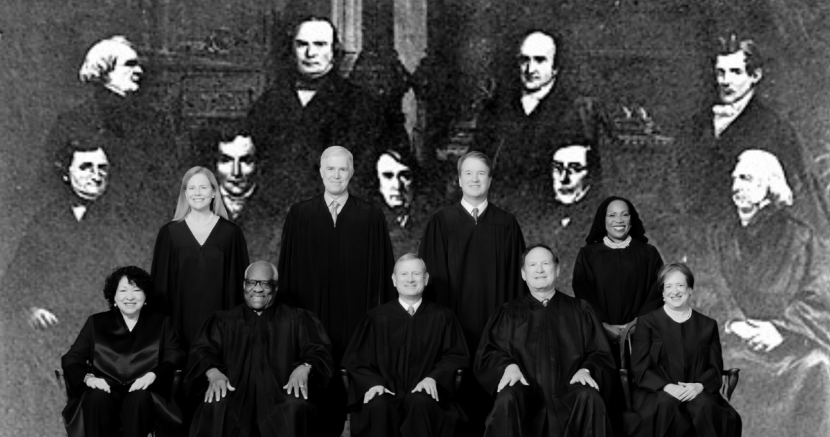
The Supreme Court is often described as the “least dangerous” branch of the federal government. Its Justices, appointed for life, were envisioned as a counterbalance to the political branches. Yet history tells us something different: the Court has always been political, always influenced by the values and compromises of its time.
My own ancestors lived through the Dred Scott decision, which declared that people of African descent, free or enslaved, were not citizens. In the 1880s, the Court struck down Congress’s efforts to stop racial discrimination in businesses and public accommodations, a ruling whose shadow still lingers today. More than a century later, the Court continues to grapple with race and power, often narrowing the very tools designed to address the very historical discrimination woven into the fabric of this country.
During World War II, as our nation condemned tyranny abroad, the Court upheld the legality of interning Japanese Americans and segregation at home. Decades later, it decided the 2000 presidential election, halting a recount that might have changed the course of history. More recently, the Senate refused to hold hearings on one nominee while rushing through another. These choices reinforced what many already knew: the Court is not above politics. It never has been.
The consequences of this reality are profound. Justices have suggested that rights to contraception, rights of same-sex couples, and marriage equality may be on the chopping block. The Court has opened the floodgates to private money in our democracy. It weakened state gun safety laws just weeks after the school shooting in Uvalde. And now, in cases like Louisiana v. Callais, the Court has made it significantly harder to challenge racial vote dilution, requiring plaintiffs to meet increasingly narrow standards that focus less on real-world impact and more on abstract notions of intent and neutrality.
In doing so, the Court has created a framework where discrimination must be proven in forms that are often disconnected from how it actually operates, embedded in structures, intertwined with politics, and reinforced over time. These rulings reflect not timeless principles, but the perspectives of individuals with personal and political convictions. That is the system the founders created: one in which immense power rests in the hands of people who were never meant to be beyond scrutiny.
So what do we do in the face of this reality? We can remember that the Court has never been the final word on justice in America. When slavery was law, there was the Underground Railroad. When Jim Crow reigned, there was the Civil Rights Movement. When police raided Stonewall, the LGBTQ+ community resisted. And, now that the Voting Rights Act has been effectively gutted, citizens must keep organizing, voting, and working to preserve our country’s multi-racial democracy. Time and again, the people have protected humanity when institutions refused, and we must meet this current moment with the same vigor and tenacity as those who came before.
Even in moments of hopelessness, communities must meet the challenge. When the systems fail, the people must organize. The struggle for democracy, equality, and dignity does not begin and cannot end in the courtroom. It must forever rest with people refusing to accept injustice as a permanent fixture in our society.
The Court’s legitimacy is not secured by robes or marble columns. It is secured, if at all, by the people’s belief that justice is still possible. And that belief must be earned, not demanded.
The Supreme Court has never been above politics. Its decisions are powerful, but they are not sacred. And as recent rulings demonstrate, they can just as easily constrain the pursuit of equality as they can advance it. In the end, democracy rests not with nine justices, but with millions of Americans willing to hold power accountable.
And, we must show up and exercise our right to vote to make sure our democracy will forever be for and by the people.
Louis A. Bedford IV is a civil rights attorney in Dallas and Washington DC, and the Progress Texas Institute board chair. He is a graduate of the University of Texas School of Law. He previously worked with the Texas Civil Rights Project as a part of the Election Protection Coalition to facilitate a nonpartisan Election Protection hotline for voters. He is formerly an Attorney at Law with West & Associates LLP and the former Legal Counsel for the Office of Texas State Senator Royce West. He is currently a volunteer attorney with the Dallas County Democratic Party and has established a county-wide voter protection program. He is formerly a staff attorney with the Democratic National Committee. He is now a Policy Counsel with the NAACP Legal Defense Fund.
DONATE
Your donation supports our media and helps us keep it free of ads and paywalls.