
This is an excerpt from the Progress Texas Daily Dispatch, delivered every weekday by Progress Texas Communications Director Chris Mosser. Rapid response on the breaking news stories Texas progressives need to know—all in less than 10 minutes!
Click below to listen!
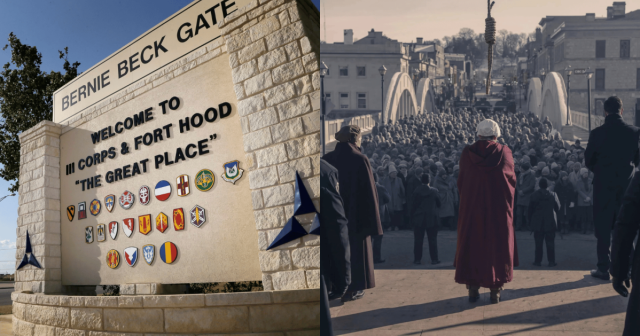
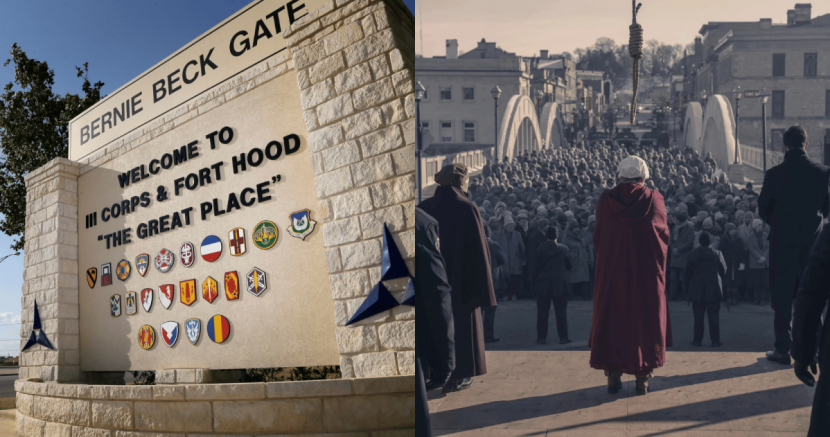
The first thing I think of with this whole public execution thing at Fort Hood is The Handmaid’s Tale—which we much more commonly invoke, obviously, when discussing reproductive freedom and Christian nationalism—but if you watch that show you’ll note that garish, violent public executions are central to that universe, and the fictional government of Gilead’s use of fear to keep its population in line.
Sig Christenson at the San Antonio Express News says the U.S. Army has scheduled the execution of Nidal Hasan, the mass murderer who killed 13 people and wounded at least 31 others at Fort Hood in 2009, to take place at the site of that killing on that Texas base on December 3, and the Pentagon has announced that Trump Secretary of War Pete Hegseth suggested to the president that a livestream of the execution be made available, an idea that Donald Trump found deliciously delightful. If this happens, it will be the first public execution in the United States since 1936.
The question here is not about whether this killer deserves justice: he does. Nor is it about whether the countless people whose lives were ended or wrecked by this single horrible act deserve justice and closure: they do. The problem here is converting that justice and closure into a cruel, barbarian spectacle meant to instill fear of the state as much as to deliver accountability.
Public executions persist in countries including Iran and Taliban-controlled Afghanistan, where those Islamic fundamentalist regimes use them to demonstrate state power and intimidate the public. These totalitarian states don’t broadcast violence to serve justice. Rather, they do it to project absolute dominance, terrorize political opponents, and condition citizens to equate state power with cruelty—to see their leaders as threatening overlords, not as trusted stewards of a beloved state. America abandoned this knuckle-dragging practice after generations of experience showed how these events were more spectacles of bloodlust than representing anything remotely positive or constructive. By regressing towards brutal anachronism, the Trump administration signals an open embrace of the autocratic governance that only exists today in places that, until recently, had been considered our ideological and cultural foes—North Korea is another prime example of a regime that bathes in the blood of its outcasts, and when an American president looks to brutal, retrograde dictatorships like these for inspiration, all of America loses any right to call ourselves a global custodian of human rights.
The decision to broadcast this execution marks yet another chilling departure from constitutional norms under Donald Trump. One thinks of recent characterizations of ICE protestors as terrorists, and the classification of “Antifa”— still largely without any commonly-held definition—as a terrorist organization. How long until Trump opts for public punishment of his political enemies?
To once again be perfectly clear: this mass murderer deserves his punishment. While many of us oppose the death penalty altogether, we all agree that justice must be done. That said, anyone who values common decency and civility should be horrified by the decision to turn it into a show.
DONATE
Your donation supports our media and helps us keep it free of ads and paywalls.