
Karmelo Anthony Trial Exemplifies Justice System Inequities For Black Texans
Portions of this article appeared on the Progress Texas Daily Dispatch, delivered every weekday by Progress Texas Communications Director Chris Mosser. Rapid response on the breaking news stories Texas progressives need to know—all in less than 10 minutes! Click to listen!
On June 9th, 2026 a jury in Collin County sentenced Karmelo Anthony, a Frisco teenager, to 35 years in prison to life, finding him guilty for the fatal stabbing of Austin Metcalf at a high school track meet in April 2025. This case was bombarded by public attention and racist vitriol online, and sparked intense debate about the deep systemic flaws built into our justice system that fail to deliver justice for Black Texans.
Frisco and Collin County are a rapidly diversifying part of Texas and have become a flashpoint for racial tension. That’s the setting for this trial, which featured a jury that excluded Black Texans, for the sentence of this Black 19-year-old. The state through State District Judge John Roach Jr. (an elected judge, vs. appointed) sifted through 600 Collin County residents, and struck the only remaining Black candidates left in the jury pool, three Black women, citing the “race-neutral” reason that the three were educators. And with that the trial ensued, with opening arguments on June 4.
Overview of the Karmelo Anthony Trial
Elissa Jorgensen, Sarah Bahari, Chase Rogers at The Dallas Morning News reported on the details of the case, sharing that both teenagers were 17 at the time of the killing on April 2, 2026. That’s when, witnesses say, that “Metcalf pushed Anthony, who said Anthony then pulled out a [pocket]knife and stabbed him in the chest. The teens, both from Frisco, didn’t know each other.” Prosecutors argued that Anthony provoked the confrontation: which according to Texas law, would name him the aggressor and incapable of arguing self-defense. Meanwhile, Anthony’s defense attorneys claimed self-defense, saying he made a split-second decision in the face of a threat from teenagers larger than him.
Anthony did not testify, with only his mother, Kala Hayes speaking for him to the jury. Their family was especially subjected to the gratuitous, violent misinformation campaign online from @LibsofTikTok and its ilk, which featured falsified autopsy reports, fake Instagram screenshots, and even death threats.
Hayes begged for the jury’s mercy, and lamented that she knew he was sorry, met by his tears in the court. The Metcalf family also addressed the court, and Anthony, with victim impact statements. Austin Metcalf’s father, Jeff Metcalf, also described “how his and Meghan Metcalf’s homes had been targeted by fake 911 calls meant to draw a large police response, and how narratives around the case had wrongly centered on race. “It made me realize how cruel people can be,” he said.”
All in all, the non-Black jury heard from both families, from students who are minors themselves, police officers, and saw videos from the event. The non-Black jury found Karmelo guilty on Tuesday, June 9th, sentencing Anthony to 35 years in prison and $0 in fines while rejecting the sudden passion defense introduced by Anthony's attorney. He would not have received the death penalty because he was younger than 17 at the time of the stabbing, and the jury did not opt for the manslaughter defense available to them.
Public Reactions to Sentence
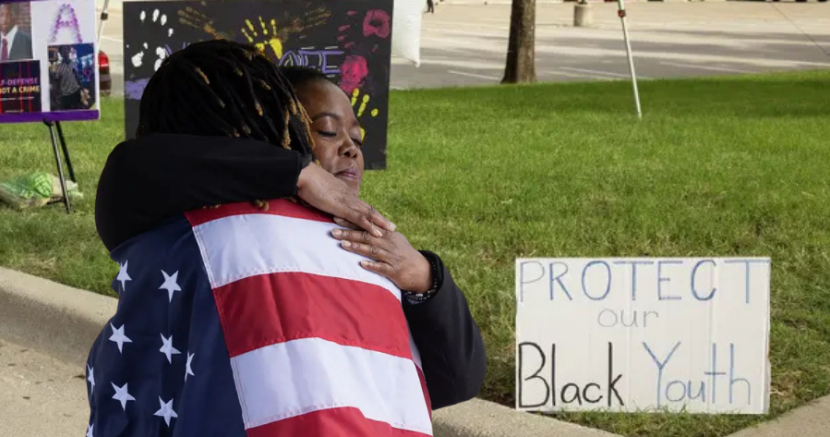
The rapid three-hour deliberation only amplifies concerns of implicit bias, indicating a rush to judgment rather than a meticulous review and deliberation of the self-defense arguments presented by Anthony’s attorneys. Outside the building, members of the NAACP LDF, Next Generation Action Network, and supporters of both teens had gathered for days, praying, holding signs, and waiting for the verdict under heavy police presence. One person in attendance, Lorenzo Henry, a pastor at Kingdom Application Ministries in McKinney, said “No one should be losing children at such a young age, being dead or in the system,” Henry said. “Nothing good can come from this that I see except God do something about it. And so we're gonna let God be God and just pray that he intervenes like he's never done before.”
After the decision, the scene escalated into fierce face-to-face confrontations Tuesday, the entire situation another notching up of the racial division that has come to define the political nature of Collin County. One tragedy met with another, and a push for every Texan to advocate for our neighbors, especially our criminalized Black Texan neighbors, to be protected and treated equitably by our unjust justice system.
What’s Else is Going on in Frisco?
All of this happened on the last day of early voting in the Frisco mayor’s race, itself having become a referendum on racial tension in North Texas. Molly Hennessy-Fiske at The Washington Post does a deep dive on Frisco’s increasingly fraught environment, which in just the last few years has seen a rapid demographic transformation to 46% White, 34% Asian, 10% Latino, and 10% Black—a situation that has attracted outside right-wing provocateurs seeking to stoke the flames of explicit anti-immigrant rhetoric targeting the city’s non-White residents, who now represent Frisco’s majority. The agitators outside the Karmelo Anthony trial are just the latest example: right-wingers have held court during public comment periods at City Council meetings to disparage people of color, to mock cultural practices, and to actively protest the construction of local mosques and Hindu temples—a trend that the statewide GOP, including Governor Greg Abbott and Attorney General Ken Paxton, have been all too eager to exploit.
The fact is, the Black community of Texas has every reason to see the circumstances of the Karmelo Anthony trial as a continuation of the legal deck stacked against them in our state. Michelle Davis posted in her Lone Star Left column yesterday a detailed history of egregious injustice against Black Texans in our court system: “We have to be honest about what this week looked like from end to end. Nobody is saying Karmelo Anthony didn’t do what he was convicted of doing. What I’m saying is that the scales of this justice system have never balanced the same way, depending on who’s holding them and who’s standing underneath. The system didn’t fail this week. It performed exactly as designed.”
What’s next?
With the last day of early voting and trial occurring on the same day, we are left with a reminder that voting is not enough to address injustices in our state (and that judicial elections matter too!) Visit GoVoteTexas for any FAQs on voting in Texas, (available in English, Spanish, Vietnamese, Chinese Mandarin, and Hindi).
Beyond participating in elections, you can be a trusted advocate, engaged in your community, by serving on a jury if called upon.
Jury Duty is a critical civic duty, giving you the chance to protect Constitutional rights: the right to a jury of our peers. We know this standard is often corrupted or absent, but the importance of jurors who believe in equity and justice remains, and we need more people to stand up. Find out more from the ACLU, which has helpful resources on what a juror does, and how you can protect civil rights if called to serve.
Editor’s Note: Early Reporting on this story claimed that the jury for the Anthony case was “all-white.” This article was amended on June 11, 2026 to reflect the multiracial makeup of the jury, still excluding Black Texans.
DONATE
Your donation supports our media and helps us keep it free of ads and paywalls.