
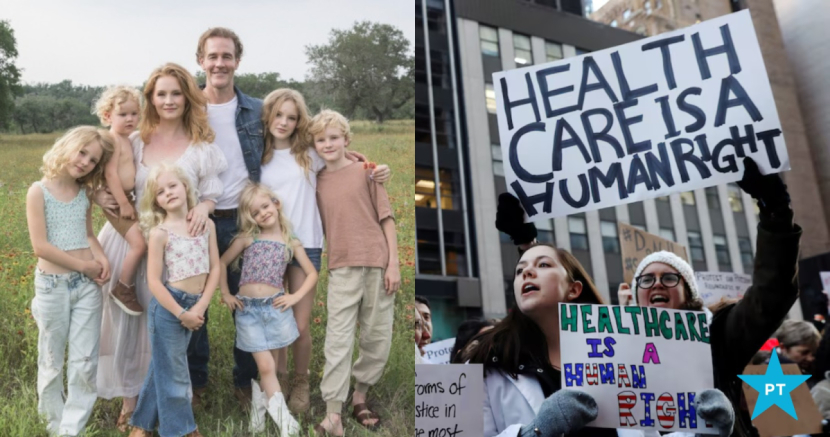
The high-profile struggle of one Texas family provides a harrowing window into the systemic failures of the American healthcare system. Actor James Van Der Beek, a fixture of American television for decades, passed away Thursday, February 11, at his home near Austin at the age of 48. After a two-year battle with colorectal cancer, he leaves behind a wife and six children. While his death is a tragedy in its own right, the financial circumstances surrounding his final years are equally staggering. A successful, globally recognized actor who once maintained a net worth nearing eight million dollars was left nearly insolvent by the sheer cost of medical intervention.
Before his passing, Van Der Beek revealed that the crushing financial weight of his treatment had forced him to auction off iconic memorabilia from his career. Today, his family relies on a GoFundMe campaign to maintain their stability. This underscores the "financial toxicity" inherent in our current model. Even those with significant professional success are not immune to a system where out-of-pocket maximums and coverage gaps lead to bankruptcy. It exposes the "middle-class trap," where modest assets disqualify families from social safety nets yet prove insufficient against the astronomical costs of modern oncology.
James Van Der Beek’s story mirrors a systemic crisis that is intentionally worsened by state policy in Texas, where the tragedy of medical bankruptcy isn't just a byproduct of high costs — for many families facing similar tragedies, it is the result of a deliberate political refusal by Republicans to accept the expansion of federal Medicaid benefits under the Affordable Care Act. This is an already-paid-for and common sense safety net that most other states - notably including West Virginia, the Dakotas, Wyoming, and Idaho, all of which are ruled by even stronger GOP majorities than Texas — have already adopted. North Carolina has recently followed suit, rendering Texas even more an unreasonable holdout. By stubbornly and inexplicably remaining one of the few states to reject federal funding for expansion, Texas maintains the highest uninsured rate in the nation, and experiences very high instances of the coverage gap in which hundreds of thousands of Texans earn too much to qualify for traditional Medicaid, but too little to afford private insurance premiums. In expansion states, Medicaid acts as a vital backstop that prevents "financial toxicity," a clinical term for the physical and emotional toll that the cost of care takes on a patient. In Texas, that toxicity is systemic. Without Medicaid expansion - again, a Republican policy choice - the burden of uncompensated care shifts to local taxpayers and emergency rooms, while middle-class families and, in the case of the Van Der Beeks, even moderately affluent families are often forced to liquidate every asset they own just to stay alive.
I asked Dallas State Senator Nathan Johnson in early 2025 on our podcast about why he thinks Texas Republican lawmakers are so dug in against this easy and politically palatable way to help millions of Texans - his answer: “There isn’t a good argument against it. It’s essentially that, ‘we don’t want to do that because we already said we don’t like it, and we don’t want to reverse positions on it’”. Progress Texas Institute Board Member Scott Elphingstone, an expert on community health centers, a frequent care source for Texans of limited means who live in the growing healthcare “deserts” that stretch across our state, says the factors that have affected the Van Der Beek family extend far beyond our failures on Medicaid: “The U.S. has the highest-cost healthcare in the world…it just doesn’t add up, the money we spend versus the fact that we leave so many people without coverage when that time of need comes. It’s just crazy…somewhere around 18% of our gross domestic product for healthcare. We’re half-again more than the next similar industrialized democracy…it’s enormous. There’s something way deeper than just Medicaid that’s wrong with healthcare in this country.”
The fact that the family of a successful, internationally beloved actor must turn to crowdfunding in order to remain solvent after his passing serves as a grim indictment of a for-profit system that treats life-saving care as a commodity - and very few of us are safe from its shortcomings. This reality is unacceptable. At the end of our lives, when we’d all want calm, comfort, clarity and no concern beyond the embrace of our loved ones, Americans more and more see that critical moment of transition marred by worries about the futures that await those loved ones. This is fundamentally wrong, morally reprehensible, and as seen across most of the rest of the advanced world, totally unnecessary. Real, substantive and immediate change to the American healthcare system is no longer a suggestion or a luxury - it is a concrete necessity that must be demanded at the ballot box.
What’s Next
- Share our voter navigation resource GoVoteTexas.org with friends for a handy guide to voting in this election—now available in English, Spanish, Vietnamese, Chinese Mandarin, and Hindi!
- Are you a 2026 candidate running on our shared bold progressive values? Apply to be recognized as a Progress Texas Institute “Certified Progressive.”
DONATE
Your donation supports our media and helps us keep it free of ads and paywalls.